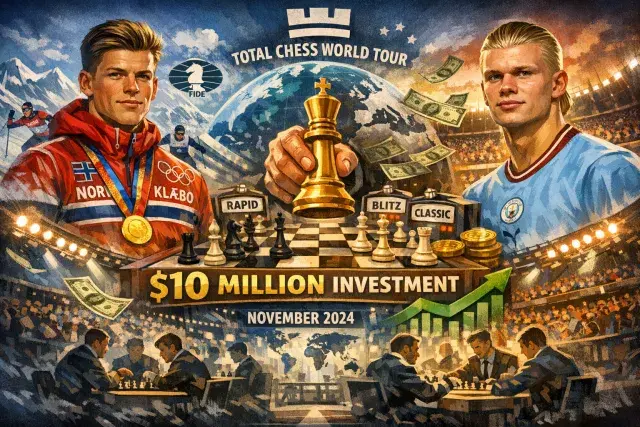
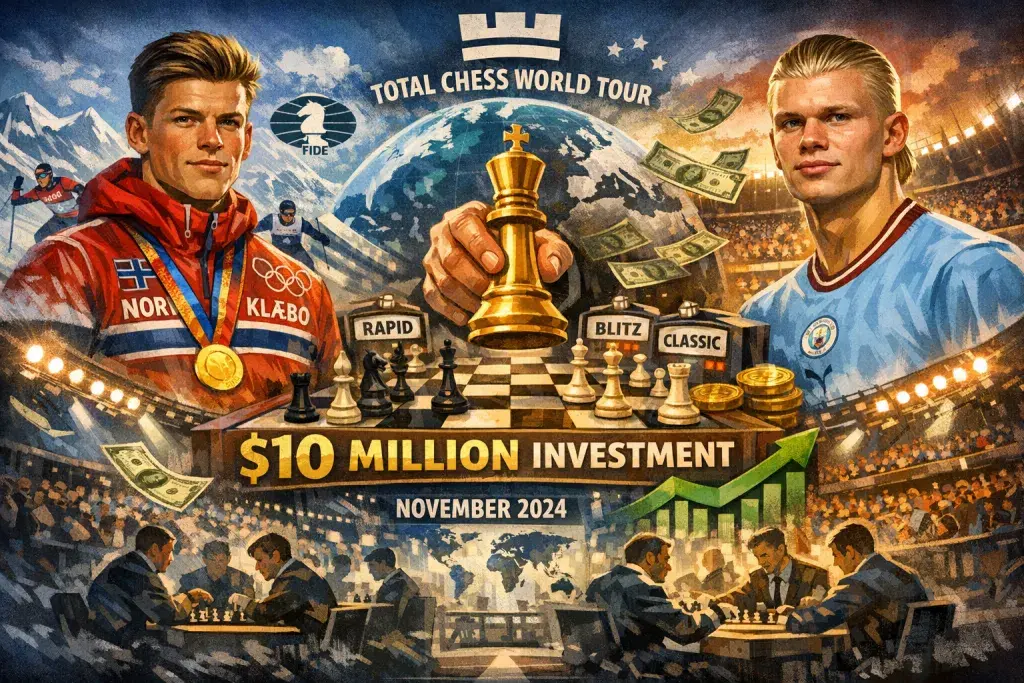
Cross-country skiing icon Johannes Høsflot Klæbo, holder of eleven Olympic gold medals, has committed capital to the Total Chess World Championship Tour, joining footballer Erling Haaland in backing the Norway Chess-led initiative. The two form part of a broader investor group that has collectively added $10 million to the project, which carries formal approval from FIDE, the governing body of international chess. A pilot event is scheduled for November 10–24, with a full global rollout targeted for 2027.
What the Total Chess World Championship Tour Is Designed to Do
The venture is built around a structural idea that has quietly gained traction in chess circles: that no single format tells the complete story of a chess mind. The Tour will crown a World Combined Champion across three distinct formats — Fast Classic, Rapid, and Blitz — each of which rewards a meaningfully different cognitive profile. Classical formats demand sustained calculation and preparation depth over long hours. Rapid condenses that pressure considerably. Blitz reduces it to near-pure instinct and pattern recognition under extreme time constraints.
By combining all three into a single competitive arc, the Tour positions itself as a more comprehensive measure of overall chess excellence than any individual world title currently offers. FIDE's endorsement matters here: it signals institutional legitimacy and distinguishes this initiative from the various unsanctioned exhibitions and invitation-only events that have periodically tried to reshape the chess calendar without lasting effect.
Arctic Securities, the Norwegian financial firm advising on the capital raise and serving as placement agent, lends a further layer of professional structure to what might otherwise read as a celebrity-funded passion project.
Why High-Profile Non-Chess Figures Are Investing in the Game
The involvement of Klæbo and Haaland reflects a pattern visible across several intellectual and competitive domains over the past decade: elite figures from one field deploying capital and public attention into adjacent areas they find culturally compelling. Chess, in particular, has experienced a well-documented surge in global interest — a trend accelerated by the success of fictional dramatizations of the game, the rise of online platforms with tens of millions of registered users, and the emergence of a generation of grandmasters who communicate fluently with younger audiences through digital media.
For Norway specifically, chess carries unusual national weight. The country produced Magnus Carlsen, who dominated the world rankings for over a decade and remains among the most recognized figures in the game globally. The Norway Chess event held annually in Stavanger is already among the most prestigious elite invitationals in the world. Against that backdrop, Klæbo's involvement reads less as an eccentric crossover and more as a continuation of a national cultural investment in the game.
The Economics and Timeline of an Ambitious Restructuring
A $10 million injection at the investor stage is a substantive commitment for a chess initiative, though modest by the standards of major entertainment or media properties. The significance lies less in the absolute figure and more in what it signals: that private capital, rather than federation funding alone, is being positioned as the engine of chess's commercial expansion.
The decision to hold a pilot event in November 2024, more than two years before the full 2027 launch, reflects a measured approach. Pilot formats allow organizers to test broadcast logistics, audience engagement, and competitive balance across the three formats before committing to a permanent global structure. It also gives FIDE and the investors time to assess commercial viability without locking the entire project into an untested model.
Whether the combined format produces the kind of sustained public interest that justifies a multi-year global calendar remains an open question. Chess's recent growth has been real, but it has also been uneven — concentrated heavily in online participation and younger demographics, with live event attendance and broadcast figures still trailing far behind the game's digital footprint. The Total Chess World Championship Tour is, in effect, a structured bet that the gap between those two can be closed.